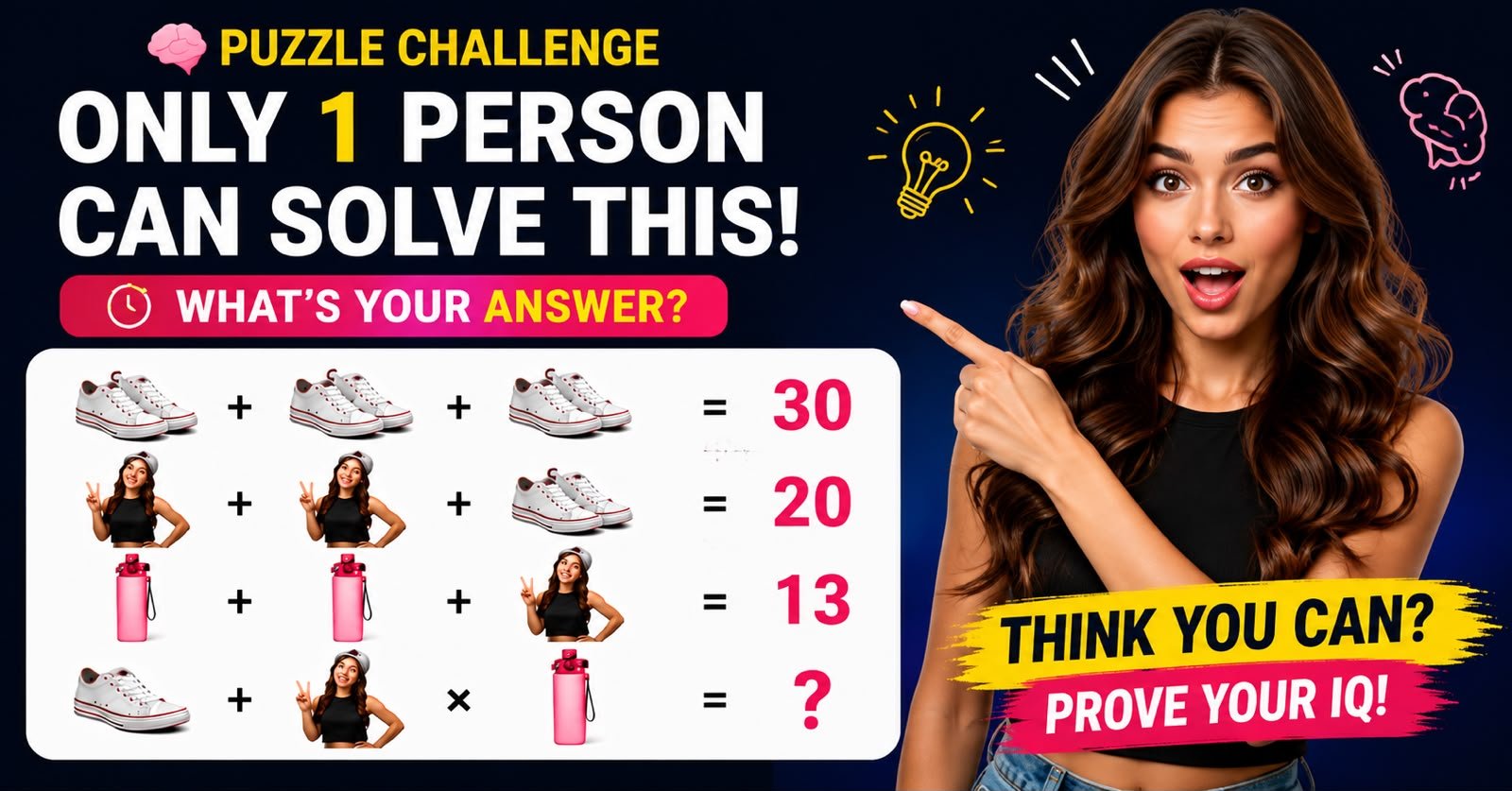
Have you ever looked at a puzzle and thought, “That looks easy,” only to realize a few seconds later that there is more to it than you expected?
That is exactly what makes brain teasers so entertaining.
[puzzle_quiz]
Visual puzzles, number challenges, and logic questions encourage us to slow down, pay attention, and think about a problem from different angles. A puzzle may contain only a few pictures and numbers, yet solving it can require careful observation and basic mathematical reasoning.
Today’s challenge is designed to test exactly that.
Before you scroll down and enter an answer, take your time. Look at every line of the puzzle carefully. Something that appears obvious at first may deserve a second look.
What Does IQ Actually Mean?
IQ stands for Intelligence Quotient. Formal IQ tests are designed to measure certain cognitive abilities using standardized tasks.
They may include questions involving logical reasoning, patterns, spatial relationships, memory, vocabulary, and problem-solving.
However, an online picture puzzle like the one below is not a professional IQ test and cannot determine your actual IQ score.
Instead, think of it as a fun brain challenge.
The goal is simple: see how quickly and accurately you can understand the pattern and find the missing answer.
Why Do Simple Puzzles Sometimes Feel Difficult?
Our brains are very good at recognizing patterns.
Most of the time, this is extremely useful. When we see something familiar, we can often understand it without carefully analyzing every individual detail.
But puzzles can use this tendency against us.
You might see the same-looking object several times and automatically assume that it always represents the same thing. You might concentrate so much on the numbers that you overlook a visual change. Or you might rush through the final equation because you think you already understand the pattern.
That is why attention matters.
A good puzzle often rewards the person who looks twice rather than the person who answers first.
Observation Is Just as Important as Math
Many people assume that picture equations are purely mathematical challenges.
They aren’t always.
Basic arithmetic certainly matters, but observation can be equally important.
For example, you may need to notice whether an image represents one item or a pair of items. You may also need to check whether something has changed between the earlier equations and the final question.
The important lesson is simple:
Don’t assume. Observe.
Before calculating your final answer, compare the pictures carefully.
Watch the Order of Operations
Another common source of mistakes is the order in which mathematical operations should be performed.
Remember the basic rule: multiplication and division are generally completed before addition and subtraction, unless parentheses or another grouping method changes the order.
This can make a major difference.
Imagine seeing:
5 + 3 × 4
Someone calculating from left to right might incorrectly treat it as:
8 × 4 = 32
But following the normal order of operations gives:
3 × 4 = 12
Then:
5 + 12 = 17
So even when you correctly determine the value of every picture, you can still get the final question wrong if you overlook the operation signs.
Why We Make Mistakes When We Rush
There is something interesting about a challenge with a question mark at the end: we immediately want to know the answer.
That curiosity can make us rush.
We see the first equation, understand the basic idea, and start calculating before fully examining the rest of the puzzle.
But speed isn’t everything.
Taking an extra few seconds to verify your reasoning can completely change your result.
Before submitting your answer, ask yourself:
- Did I examine every image?
- Did any object change?
- Am I dealing with one item or multiple items?
- Did I calculate each previous equation correctly?
- Did I follow the correct order of operations?
If you’ve checked all of those, you’re ready.
Can Brain Puzzles Make You Smarter?
You should be cautious about claims that a single puzzle can dramatically increase intelligence.
Human intelligence is much more complicated than solving picture equations.
Still, puzzles can be an enjoyable way to practice skills such as concentration, reasoning, pattern recognition, and problem-solving.
Most importantly, they encourage active thinking.
Instead of simply consuming information, you have to stop, analyze what you see, develop an answer, and check whether your reasoning makes sense.
And because puzzles are entertaining, many people are willing to spend more time thinking through them.
Challenge Yourself Before Looking at Other Answers
One of the most enjoyable parts of a brain teaser is discovering the answer yourself.
If someone immediately tells you the solution, much of the challenge disappears.
So don’t search for someone else’s answer yet.
Study each equation from the beginning.
Work out what every picture represents.
Then inspect the final equation carefully.
You might want to calculate your answer twice before submitting it.
Are You Ready for the Challenge?
Now it’s your turn.
The puzzle below may look simple, but don’t let the pictures fool you. Pay attention to the details, use your logical reasoning, and remember the correct order of operations.
Take as much time as you need.
Once you think you’ve found the solution, enter your answer below and see whether you got it right.
Think You Can? 🧠
Study the puzzle carefully.
Find the missing number.
Then submit your answer below. 👇
[840473]supplies professional anti-violence equipments and solutions for the whole world with strong and perfect production capacity. anti-violence.org